
How I Create: Kate Scott, painter
An interview with Kate Scott on finding the confidence to leave space in her work, how her process is like a silent conversation, and making art that's raw and true for you.

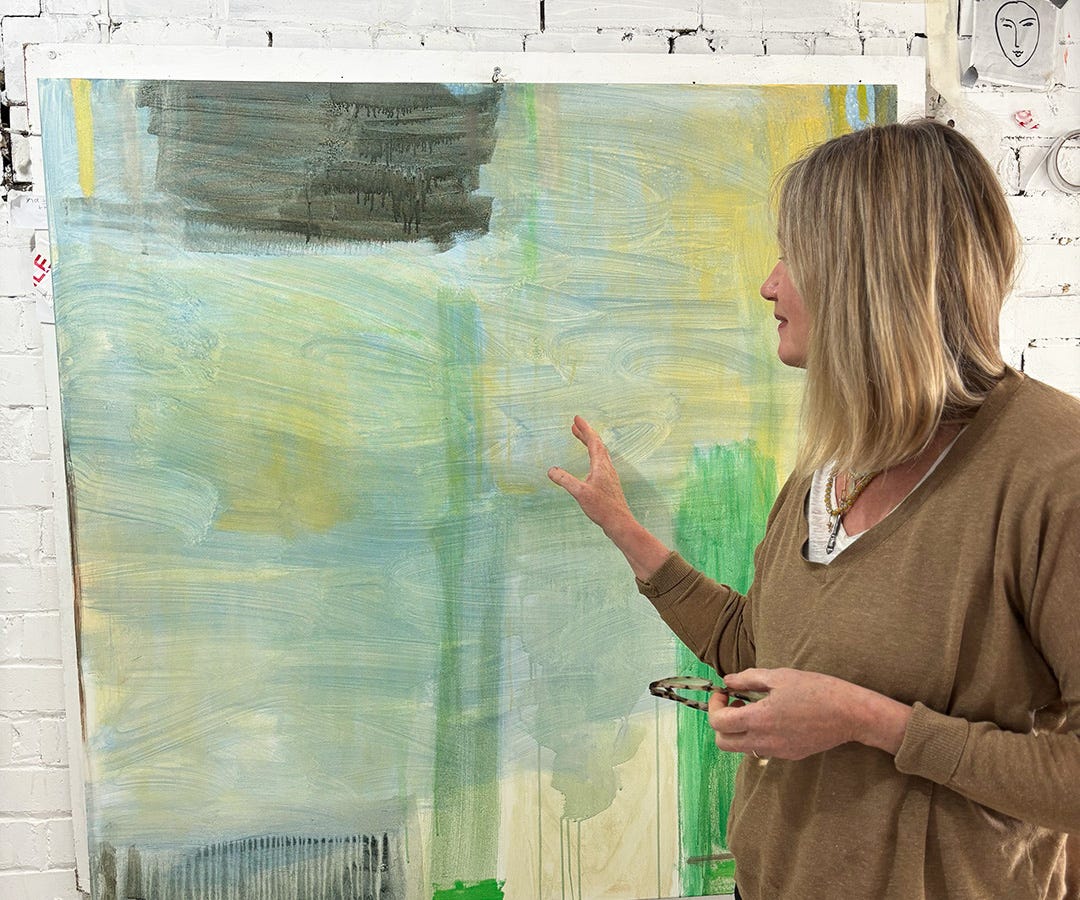
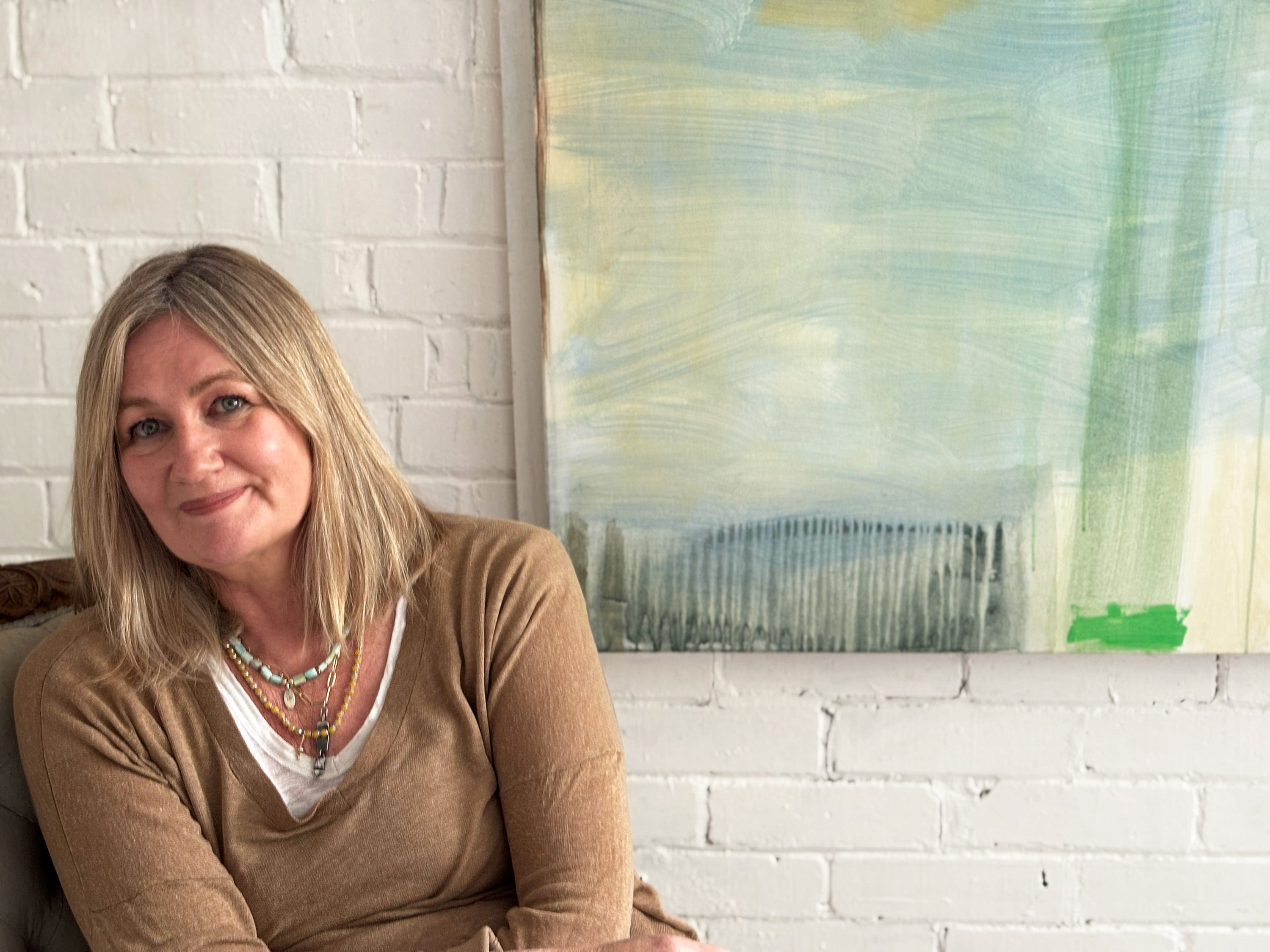
Kate Scott is an artist based in Brighton and Hove, whose paintings explore memory, longing, and grief.
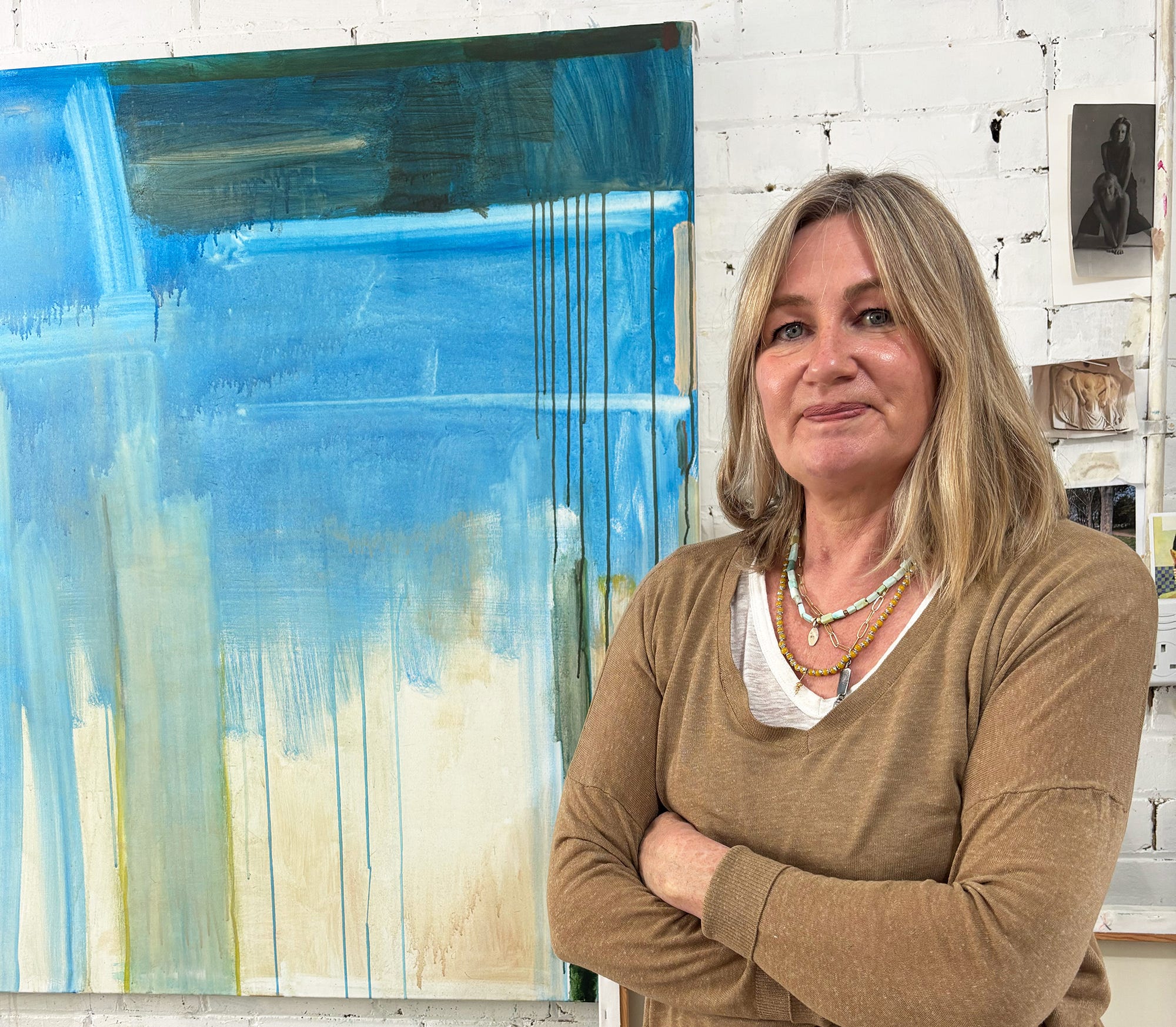
Kate describes painting as a different kind of language that comes down in an abstract form. It is like the painting is talking to her, without words, to guide her next steps; and she knows that a piece is finished when the conversation stops.
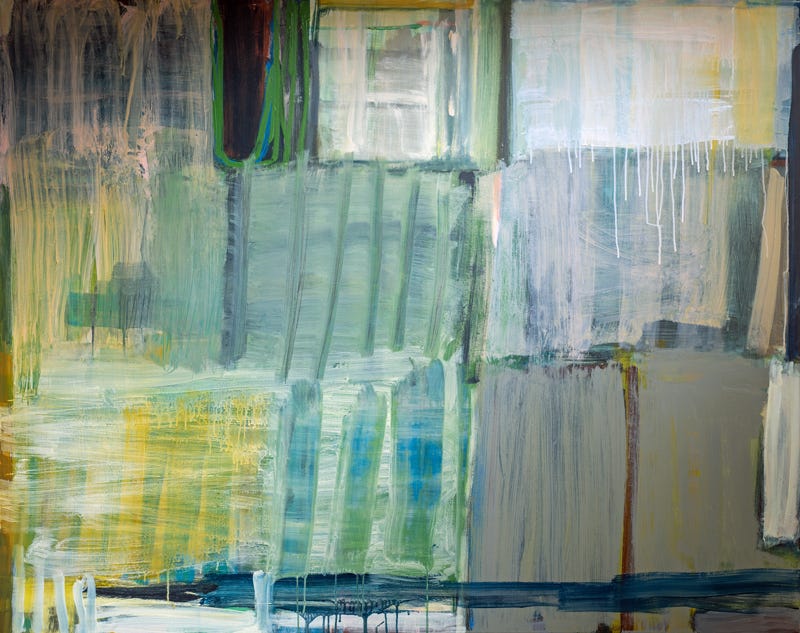
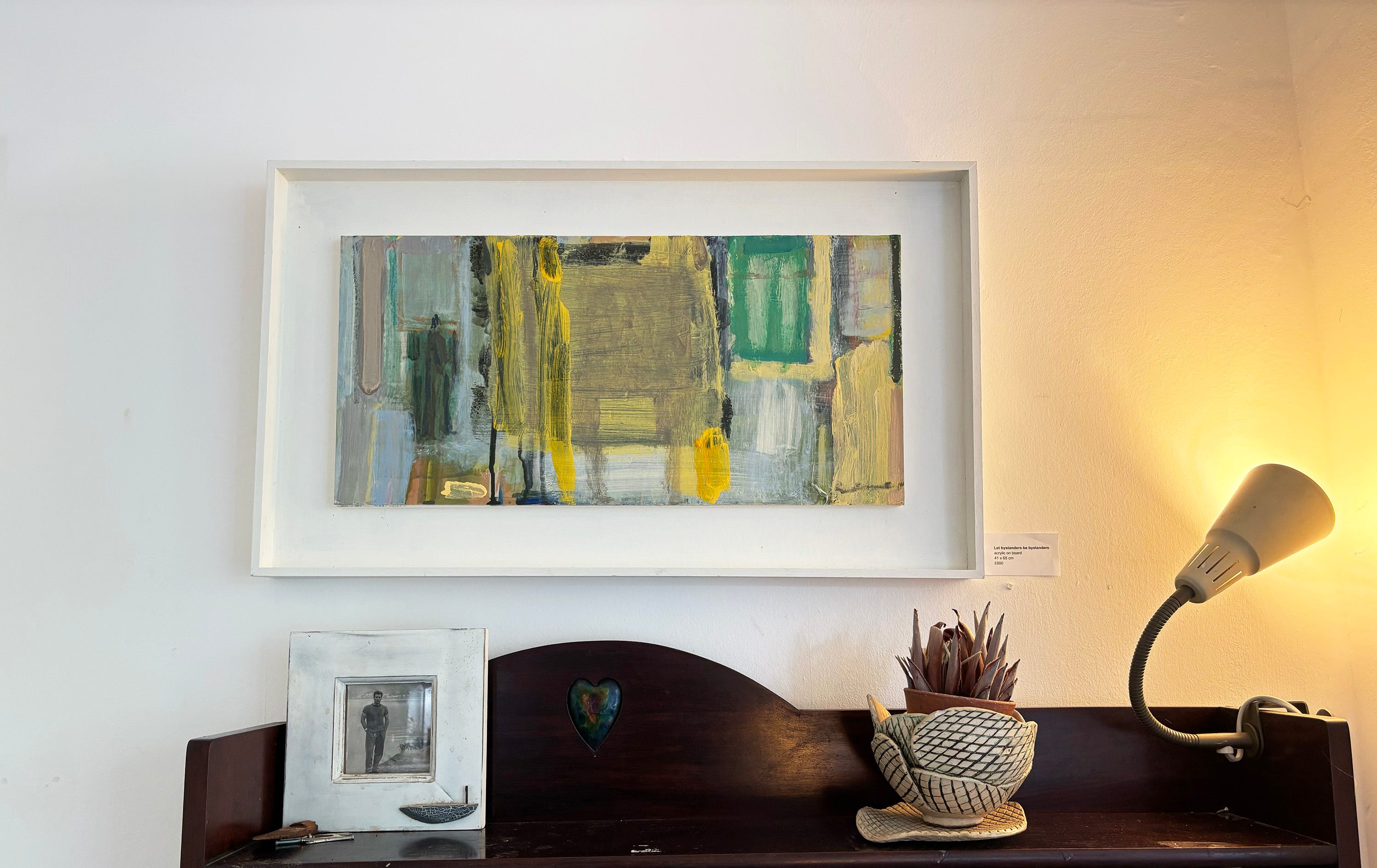
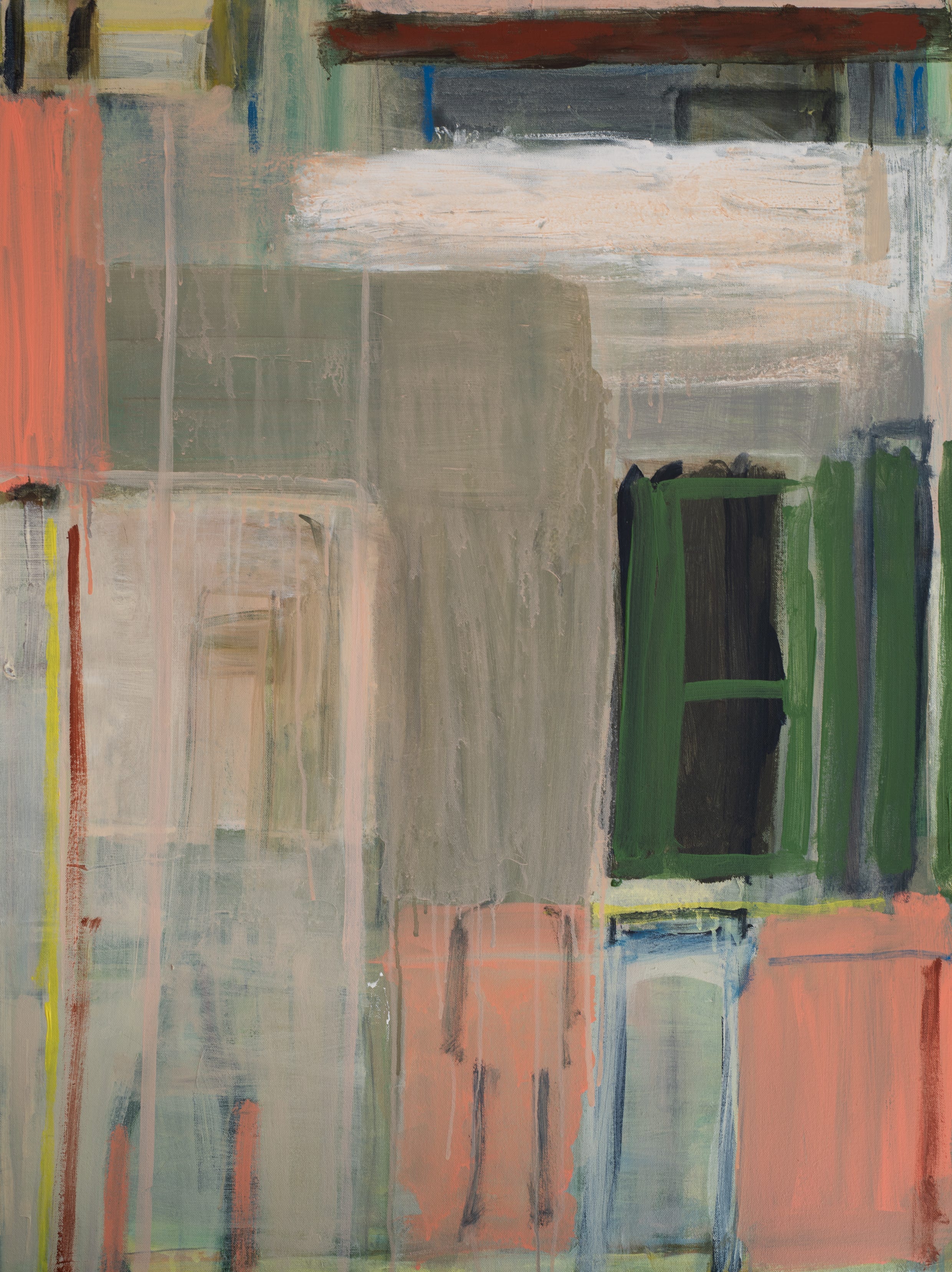
While abstract, Kate’s paintings are never just aesthetic; she wants to keep the rawness in, and a sense of potential. Sometimes it’s only at the end that the full meaning becomes clear, manifested in elements that recall places she remembers, or figures representing people in her life. In fact, during our interview she said she realised that a painting she had recently reworked now included a silhouette of a figure that resembles a much-loved photo of her late father.
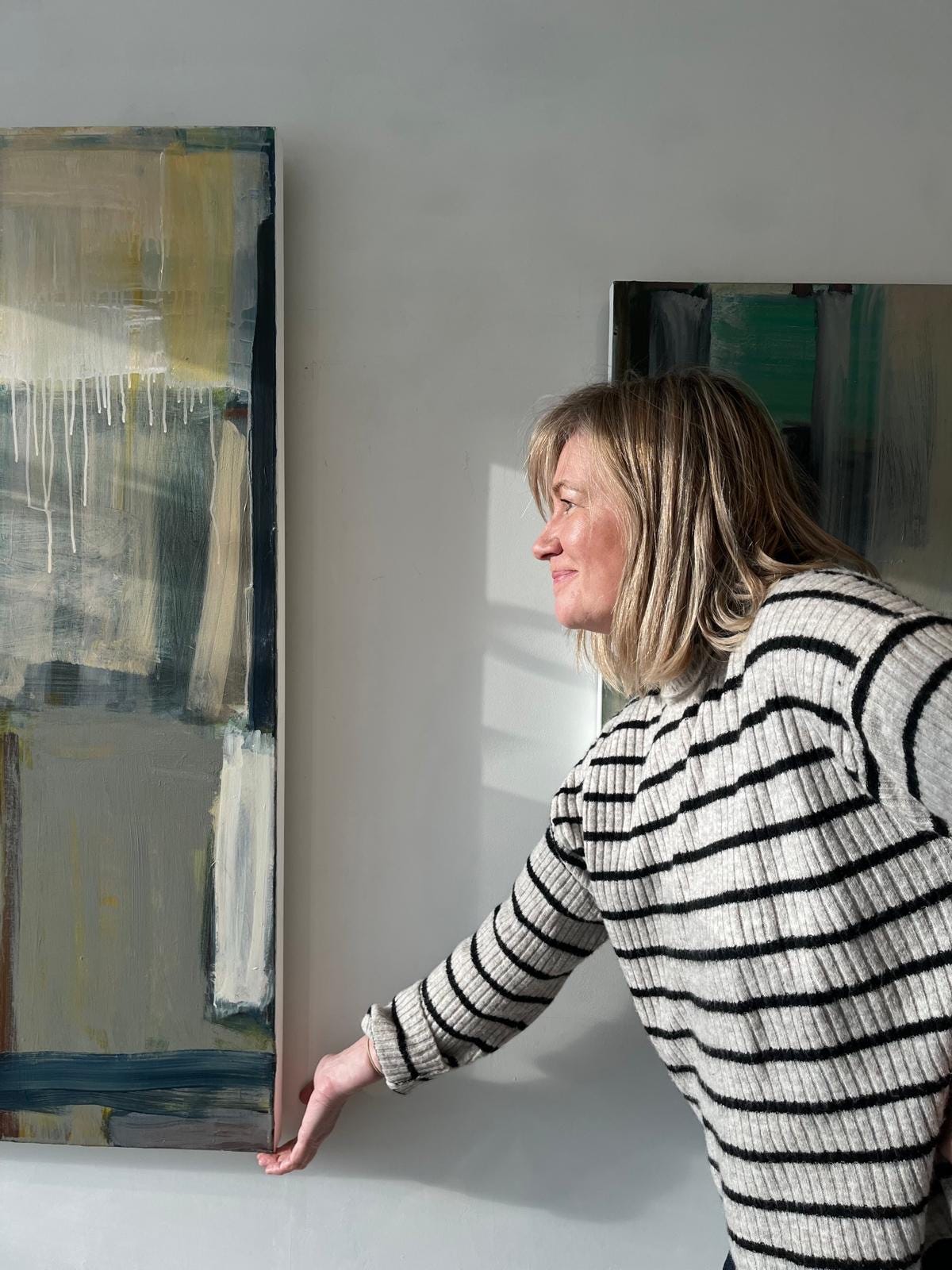
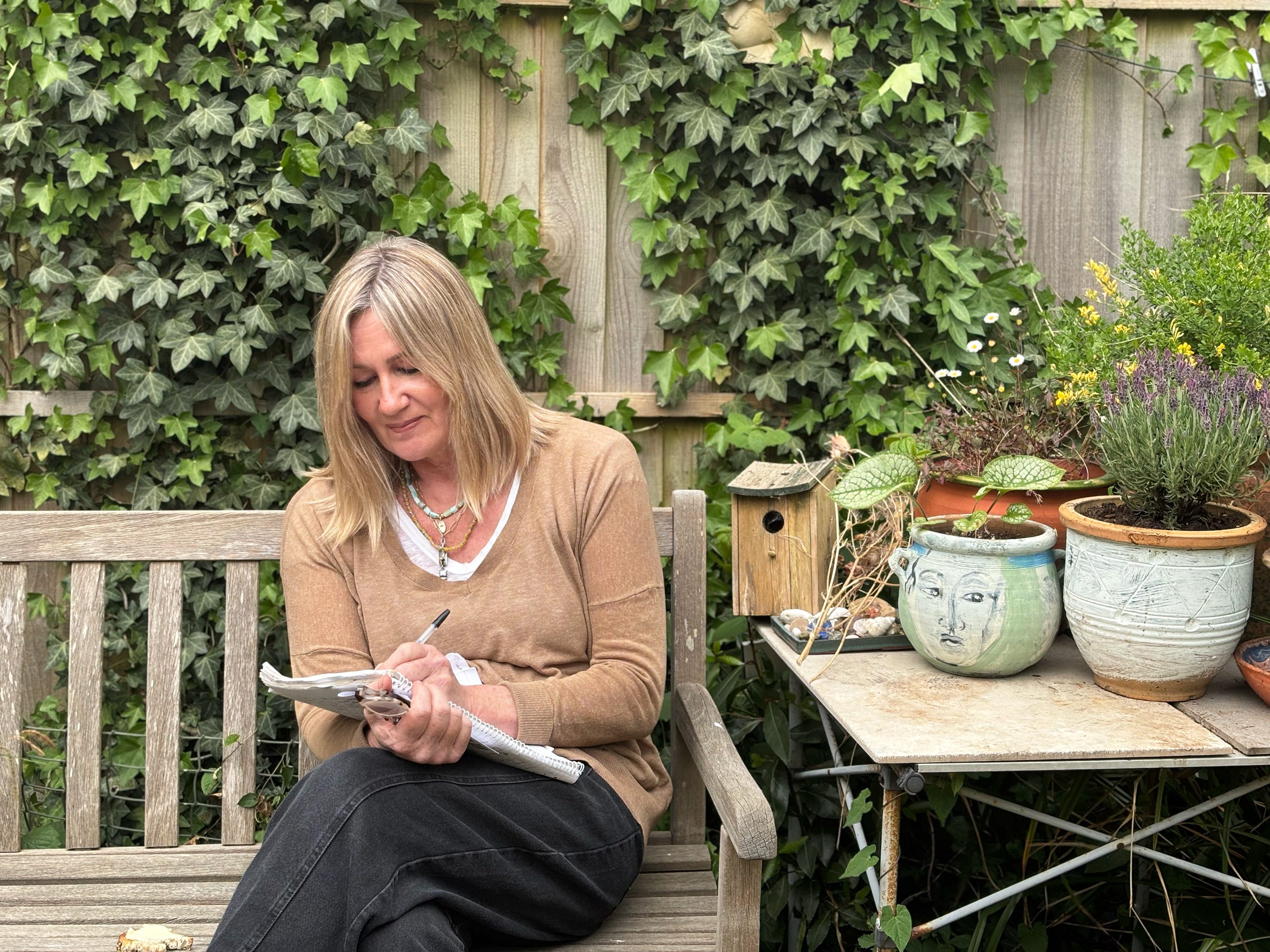
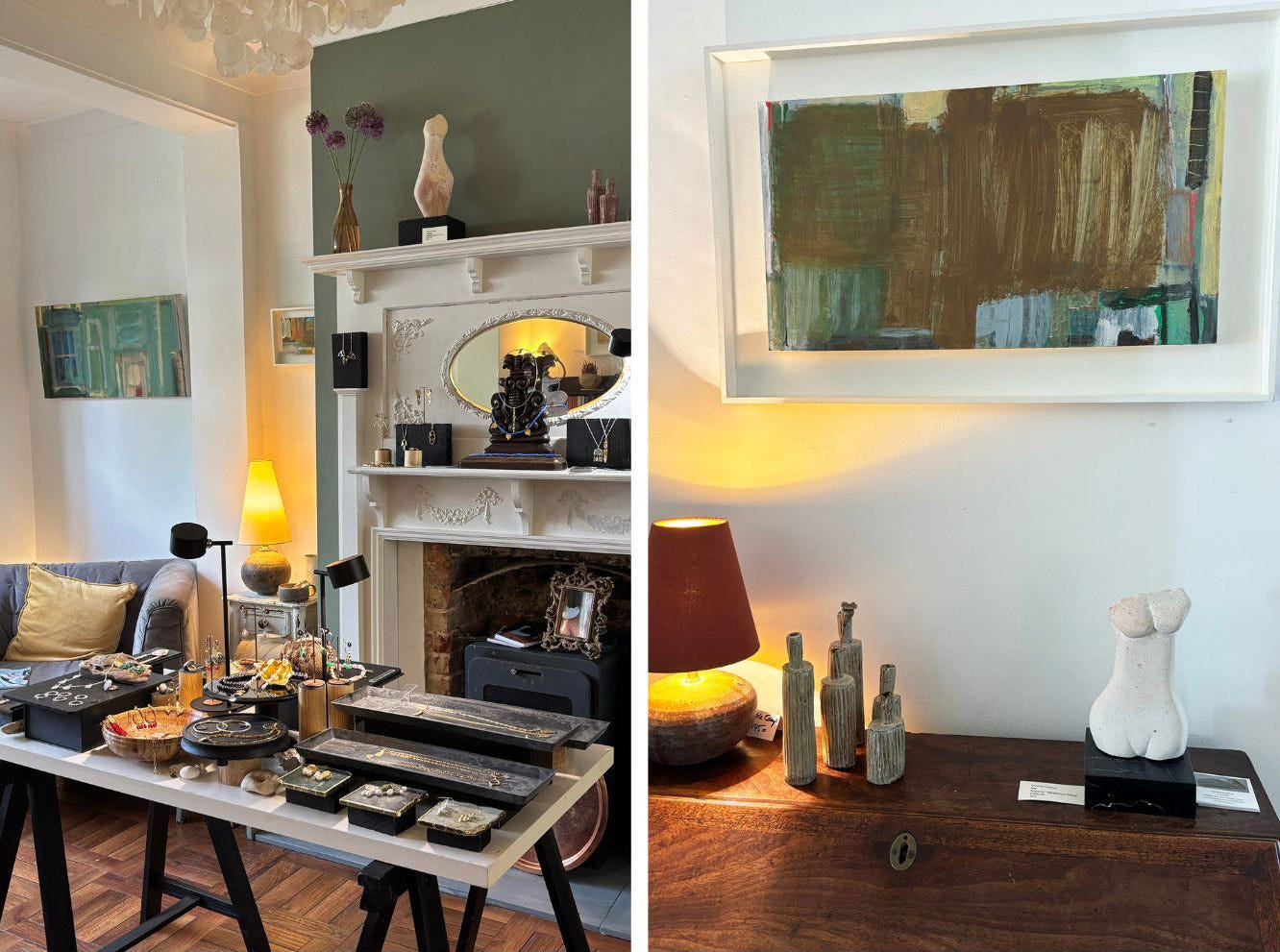
I had the pleasure of visiting Kate in her home, which she was getting ready to turn into a pop-up gallery together with fellow local artists: ceramics studio Ashdown Pottery, sculptor Davina Colmer, and jeweller Emma Stanton, from 21-25 May as part of the Artists’ Open Houses in Brighton, to hear about her creative process and work.
Can you tell us a bit about your background and story so far. How did you get started as an artist?
I’d always liked art, but I wouldn’t say I knew I wanted to be an artist. An important thing that happened at the beginning of my story is that I didn’t get into the local Foundation Course in Brighton at 17, and that was a massive disappointment. I messed up the interview, I was shy and I wasn’t prepared, and I felt like I’d failed; it felt like that was where all the cool kids were going, and I was embarrassed.
After that, I applied to Hastings College of Arts and Technology to have an interview for the foundation course, and I was a bit more confident and less attached to the outcome. It went really well, and they offered me a place, and it was the best thing that could have ever happened because it was the most amazing, varied course. I met my best friend in the world in the first week, and I could be absolutely myself without having to try and fit in.
I also met an incredible artist called Rod Harman, who is the person that inspired me to be a fine artist and empowered me to believe that I had something to say. I found my people, and I got much more confident. I could just be me, so that was an incredibly good underpinning.
After this, I applied to do fine art at Northeast London Polytechnic (now University of East London), which had amazing big studio spaces. I did really well there; I got the only first in my year, and then I was invited to do the Master’s in Printmaking in Brighton, and that was a really good two years, part-time, I learned a lot.
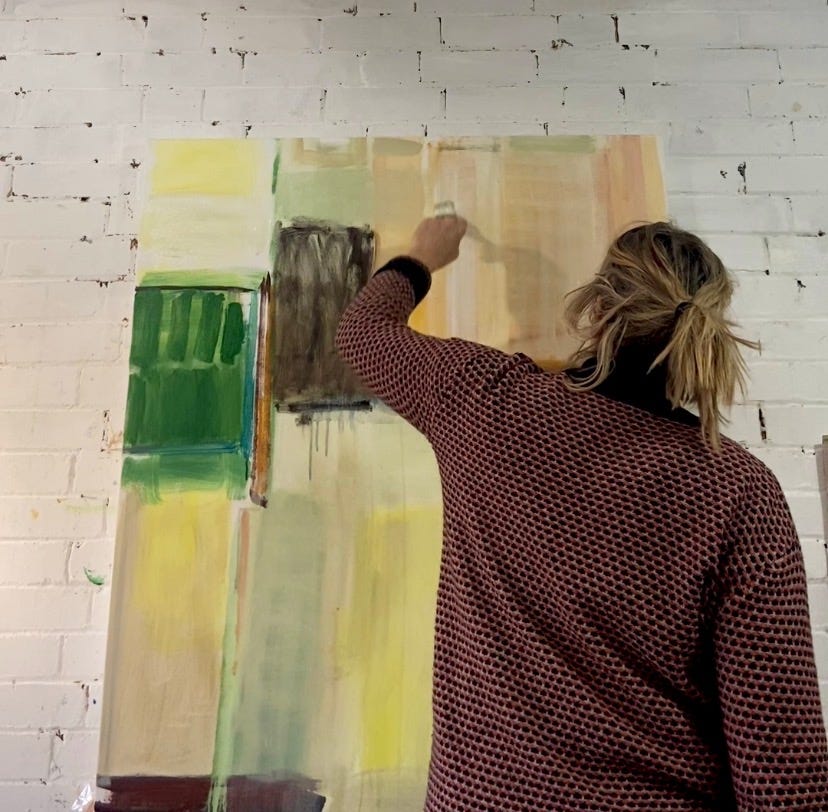
Do you work on your art full-time? What does your work/life structure look like?
I’ve always worked alongside my art, and it’s financially made it possible. I’ve done bar work, worked as an advice worker at a women’s health organisation, and later I became a counsellor at a local health charity for 16 years. To make a living fully from painting is very difficult. And also, painting is a very solitary existence. I can be on my own for six or seven hours a day, and I love it, but I really enjoy meeting and talking to people, so my other work’s always been very forward-facing.
During COVID, most of the counsellors from the health charity were made redundant, including me, and if I’d wanted to carry on working, I’d have had to move online. And for me, part of it was the structure and the team work of going somewhere else, away from home and being with different people.
Also, my youngest daughter had just finished uni, so financially I didn’t need to bring in as much money to keep everything going. Since then, I’ve been focusing on my painting, as well as a bit of mentoring.
Until very recently I’ve also been doing voluntary work with the Martlets Hospice, helping support the creative workshops for their wellbeing services and helping with their banners for Pride. It’s a team of people I feel that I belong to, which is really lovely.
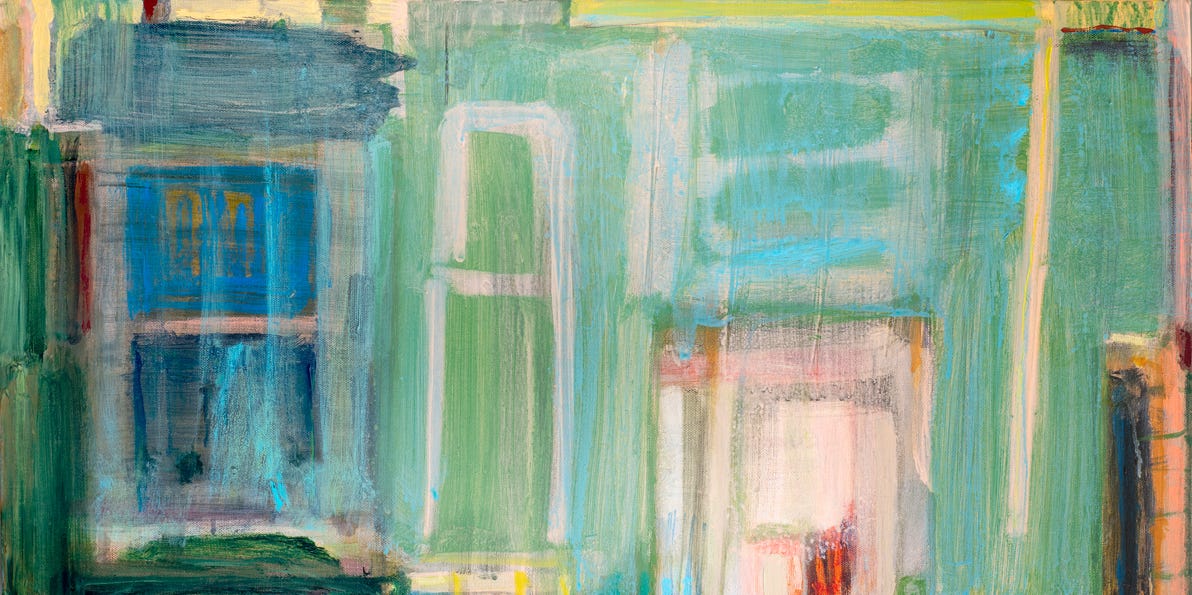
What does your creative process look like and what tools and materials do you tend to use for your work?
When I did the foundation course in Hastings, I was obsessed with life drawing. My work was very figurative, but it was getting more expressive. Eventually, when I started my degree, they said, ‘We’ve got to break you out. You’re too reliant on the figure and you need to learn how to compose, perspective, etc’. As I started painting more, I learned that I was interested in the energy and the mark-making and what that was expressing, more than the subject matter I was trying to paint, and that is how it slowly evolved and became abstract in a very natural way.
Painting (for me) is like reverse onion peeling, with each covering of paint revealing more of the truth, and the core of whatever I’m trying to say; through adding layers you are also removing layers, showing your passage through time.
My process is that I start in a very random way, and it’s like a conversation that develops between me and the piece of work. I think having my solo show last year (at Meiklejohn Gallery in Lewes) was a big confidence boost, although I already felt quite grounded in my work and believed in it, because I’ve learned to be a bit more confident in leaving space around things. Some of my work has more canvas or linen showing through now. Whereas in the past, I always felt I had to almost have a fight with each painting to make it meaningful. Like, if it was too beautiful or too successful too early on, I couldn’t cope. It would feel empty, so I’d have to sort of mess it up and then bring it back. That still happens quite a lot, but I’m learning to step back and let it be.
I’ve learned to be a bit more confident in leaving space around things.
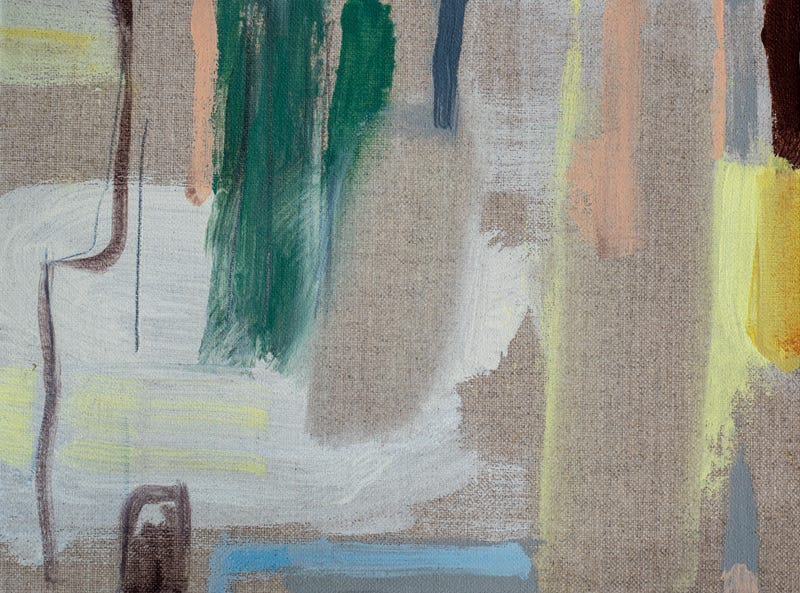
There’s one painting in the Spring show in Meiklejohn Gallery right now, that’s called ‘The Horses Have Been Held’. It’s on linen, which is this very beautiful, soft, biscuity neutral, and I built it up with lines and patches of paint, and I stood back one day and thought, ‘Leave that. It says what you need it to say, and hold your bloody horses! Resist the urge to keep adding colour.’ It’s like I’ve learned this new confidence that people won’t think I’m arrogant if I haven’t used as much time or paint in each picture.
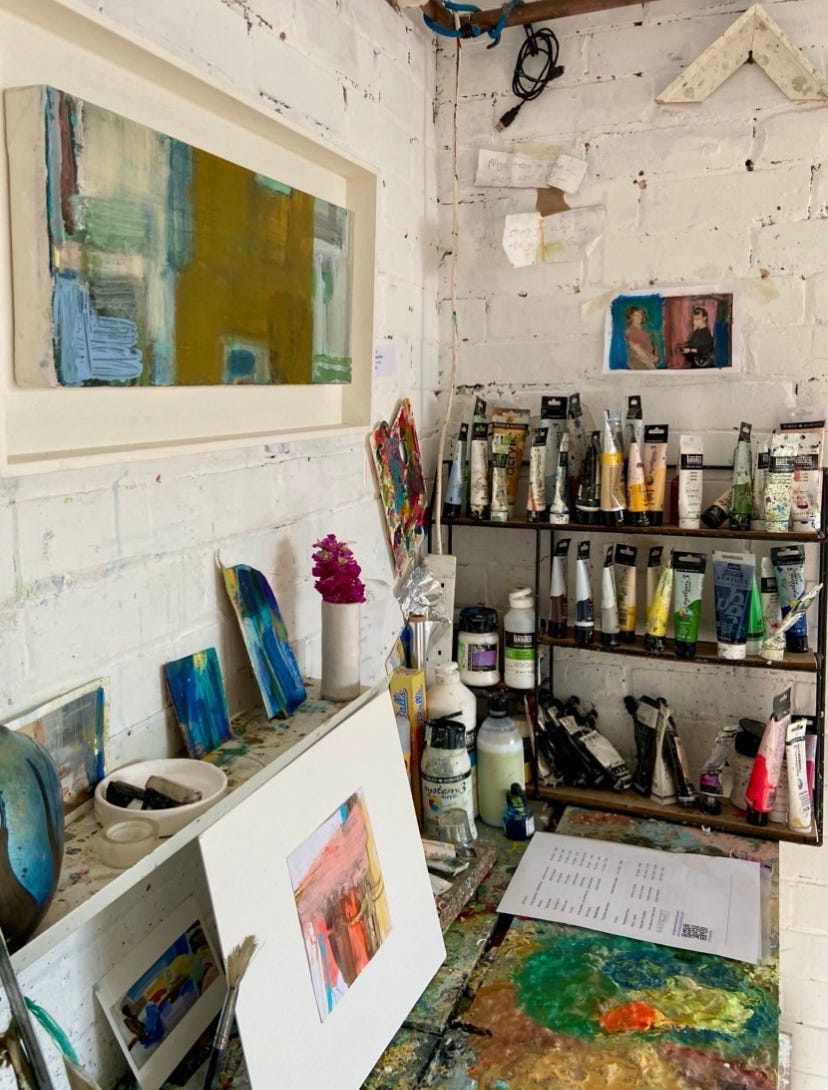
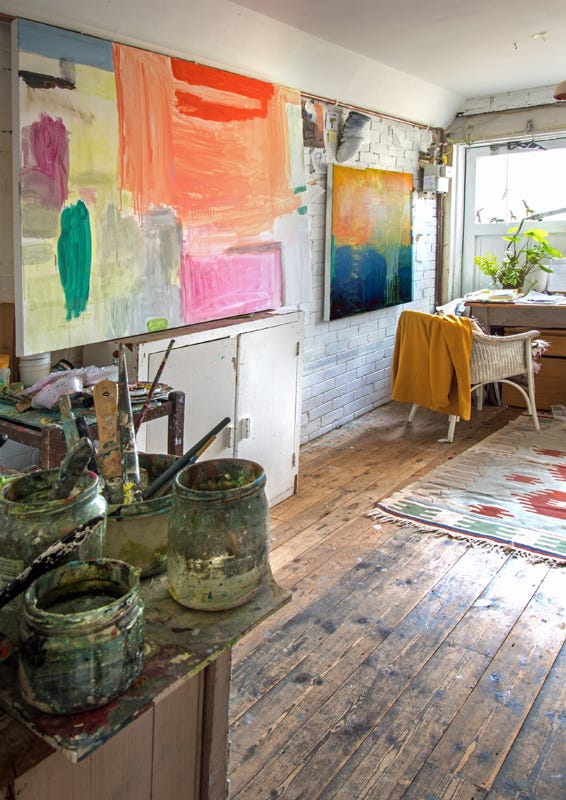
Some people have a specific process, they start with an underpainting and then they do this, then they do that. That’s not how I work. There is underpainting, but that could end up staying because it’s working, or it could end up being covered by 40 more layers!
When you start to paint, do you have in your mind at all what you want to create, or is it more of an intuitive process?
It’s really intuitive. It’s like a silent language that comes down in an abstract form. It is literally like the painting starts talking to me and it will say: pistachio green in the top right-hand corner. I know exactly the colour, how to mix it, and what brush to use. It’s just in my head, like a recipe in colour. It doesn’t say the words, I just know it in my body and I just follow. It’s almost like it exists already and I’ve just got to make it happen.
But of course, I’ve only got a certain set of skills, so sometimes I’ll put these things down and it doesn’t work, and then this process begins where I start to react to what I’ve done. But the most gorgeous place in my life is when I’m lost in that place, and I could be painting for a couple of hours and I don’t want to stop because it’s constantly feeding back to me. And then it gets to a point where it either goes really messy, or it’s all wet, or someone knocks on the door and I lose it. It’s really amazing. It just goes. I have to stay in the moment.
The subject matter as such usually comes afterwards. I think, gosh, I can see what that’s echoing, something I’ve experienced, or a memory or a place I’ve been. It’s very triggered by music as well.
What sort of music do you listen to while you’re painting?
It’s often classical music, but it could be rap, rock, or something ambient. The main thing is I don’t want a narrative, because it will tell me a story that I could end up weaving into the work without realising. The music releases something inside me that allows my own creativity to come out.
How do you come up with the titles for your paintings?
Titles are really important to me. Often they just drop in from nowhere, and it’s exciting. Sometimes they drop in when I haven’t even got a painting on the go, and I write them on a piece of paper in my studio. And sometimes they’ll never get matched to anything. It’s almost like they’re for a painting that exists somewhere else, for someone else, or it might just be a set of words that hold something for me that represents the feeling.
For instance, there’s one I did a few years ago, after my dad died, and it just announced itself. It was, ‘The Late Great,’ and it was about my dad, and I knew straight away. It’s a nice way to give someone a way into talking about the painting as well, if they’re asking. You have the odd person who struggles with any abstract art and they don’t understand how it can have a subject matter. So it’s like a companion piece to the painting, not necessarily the subject matter, but I want people to feel the sentiment of the piece.
When my mum died in 2023, they were all about loss; they were things like ‘Cleave,’ and there was one called ‘Survived’. It was about my survival of looking after her and her dying. ‘Partitioning’ was started in the last weeks of her life, and it started as an inky, dark blue, quite masculine and austere. I’d taken photos to put on social media, and I thought it was a strong painting. Then after I knew she was going, it just changed.


How did it change?
These veils of soft light, swishing and forming all over it, like golden light going up into the edges, like someone letting go and someone being untethered. So all the titles around that time were things like ‘The Space Where You Were’, and references to how I felt about trying to make sense of where she is now.
How do you know when a painting is finished?
That is to do with the conversation, and it’s when it stops talking to you. So I’ll leave it, I’ll come in the next day and I’ll either go, ‘Oh no, I thought that was really going somewhere and it’s awful, I’ve got to carry on.’ Or it’s just silent. And it’s like it’s saying, ‘Please do not touch me! I am separate from you now and I no longer need your input.’
But what can happen is, with some paintings I stop understanding them myself and I’m not comfortable; I don’t think they represent me and I don’t want to show them anymore. And then I work on top of them again. I’ve got stuff on paper that’s literally been worked on decades apart! Some paintings you would never do that with; it just works, and every little mark is connected to the whole. And sometimes it’s not even making it more aesthetic but it will be more truthful, somehow.
That’s amazing! How would you describe your work and style?
My mum had a big influence on me; she was very confident of her tastes in art. She wasn’t an artist, but she knew a lot about music and bought paintings and we were brought up seeing and appreciating all art. So as a child, I didn’t see any difference between abstract, landscape, figurative, or modern art. It was all together, which I feel is an incredible legacy she gave me; she taught me how to trust in my instincts and my reaction to visual arts and music.
I think my work’s quite lyrical because the painting is very expressive. But I have never been aiming to create pure beauty. I want to leave the awkwardness and the rawness of the process in.
A drip has to have a meaning. Sometimes I’ll blot it away, because it’s meaningless. Other times it says everything because it’s about the gesture.
I draw a lot, and I’ve studied and looked at art all my life. I take lots of photographs and I’ve found there’s quite a lot of architectural references in my paintings, as well as landscapes and elements like the horizon. Even the people who say they’re completely abstract: we’re human beings, we live in this physical world and you experience the earth beneath your feet and the light above your eyes. [We’re all] referring to our own experiences, whether we think we are or not. That’s my belief. The things that resonate are because you’ve seen and experienced them, even if they’re fleeting, and even if you didn’t notice you’d seen them.
Painting is like a silent language that comes down in an abstract form. It is like the painting starts talking to me and it will say: pistachio green in the top right-hand corner. I know exactly the colour, how to mix it, and what brush to use. It doesn’t say the words, I just know it in my body and can follow it. It’s almost like it exists already and I’ve just got to make it happen.
What advice would you give to another artist who’s struggling to develop their own style?
I’d say to really tune in to yourself, and to tune out a little bit from looking at social media and too many comparisons, because you can really easily start copying without even knowing you’re doing it. And also, don’t be frightened of the ugly stage! Be accepting that some things will never work or be finished, but then you can experiment and make a mess. You know in your heart and you can feel it in your gut when you’ve made something that’s raw and true for you.
Style, I think, is just not trying to please anyone else. The painters that are the most powerful for me, and artists, sculptors, and musicians, are the ones where they’re just channeling their authentic, true self. I know authentic’s a bit of a naff word, but I think that’s when I see work that I feel on a gut level.
What doubts or fears have you faced as a creative and how have or do you overcome them?
Just so many. I had a difficult experience when I was doing my degree, where I had a close friend who was quite jealous. It hurt because I had worked hard, and I think it dulled my ambition for quite a long time because I thought, if you’ve got your head above the parapet some people will not like you. I’ve experienced that a few times in my life and I’ve learned to process it now. I’m more mature, I’ve got the infrastructure and experience that gives me the strength to deal with it, and I’m a lot more comfortable with the idea of people not liking me or what I do, but that’s taken an extremely long time to get here.
Also, the normal doubts about your ability and impostor syndrome; I don’t do enough work; I’m not sweating over it enough. I mean, it’s just many self-doubts all the time!
Can you share a bit more on what you learned about how to process situations like the one you described?
There’s an amazing podcast that I listen to called ‘This Jungian Life’. It’s all about the teachings of Carl Jung. There was a whole episode about envy and jealousy, and how you’re representing something for them that’s nothing to do with you. It’s their thing. You’re suffering because of their insecurity.
I remember one day, having listened to that podcast, thinking, I’ve had enough of being affected by this, and I realised that even if she apologised, it wouldn’t heal that part of myself that was hurt by it, so it’s not her. It’s what it represents. And I realised that, a) I don’t want to be her friend anyway. But b) it was this understanding that she’s one person, holding a belief I have, where a light is shone on something inside me about wanting to be liked, or maybe thinking that to put my head above the parapet is to be bigheaded.
I’ve learned now that if living my life truthfully means that a small proportion of people see me through that lens, then I can handle it. But to not continue for fear of them not liking me would be a travesty. It would be a waste of who I am just to dim my light for that reason. It has taken a long time to learn that though!
Style, I think, is just not trying to please anyone else. The painters that are the most powerful for me, and artists, sculptors, and musicians, are the ones where they’re just channeling their authentic, true self. That’s when I see work that I feel on a gut level.
What’s been your proudest achievement so far?
In my creative life, two things: recently it’s having my one-woman show. I turned 60 last year and having that in the same year was major. I felt so proud. And as I say, it wasn’t that I didn’t value my own work before, but it was wonderful to be recognised in a professional gallery and to have that support. They really understood my work and believed in it.
I also love collaborating and curating. About three years ago, I worked with a cellist called Eve Whittingham, who also does sound baths and vocals and is so talented. We became friends, and I invited her to create a set of soundscapes in my studio. We managed to black it out and put in two rows of chairs, and she created a series of films on a loop, that were so powerful in the dark.
It was a proper installation and it was fantastic. People would turn up to my house and say, ‘Is this the house with the film?’ I loved the fact that we’d made that happen; it was such an individual experience and so beautiful. I just remember beaming every time someone came out with a look of ‘wow’ on their face!
What books or resources have you found most useful for developing your craft or being a working artist?
I had the book, The Artist’s Way, by Julia Cameron for about 15 years and didn’t start working through it. I was caring for my dad for about eight years and didn’t really paint during that time. It had a huge impact on my life. I did do my other work, but my life was very full with all of that. When he eventually went into a care home about 10 years ago, I signed on to do The Artist’s Way as a course in Brighton. I needed the structure and accountability of working through it in a group, and it was absolutely brilliant. I still do ‘morning pages’ three or four times a week (a journaling exercise from the book, where you free-write three pages in the morning, stream of consciousness-style). I think of it as raking the leaves in the garden, and it’s an important part of my practice.
Whenever someone comes up to me in the Artists’ Open Houses and asks, ‘how do I start?’ I just say, try The Artist’s Way if you want to get going.
I’d recommend having books around that inspire you from the artists you love the most. I also take photographs all over the place, and make voice notes to myself when I’m out for a walk. I’ve found that problems that were lurking under the surface start to be sorted when I’m out walking, and the ideas that come through are really helpful.
You mentioned that you love curating; with your Artists’ Open House coming up, what goes into putting together a collaborative show in this way?
I’ve been in lots of other people’s Open Houses over the last 10 years, and I’ve thought a lot about how to put an experience together. I love being a curator, and it seems to come quite naturally to me. In terms of how I put work together, you have to put your ego aside and think about how everyone’s work relates, not just, does mine look nice; is it in a good space? It’s the opposite of that. It’s all about the energy and the flow.
The pieces also have to work together. The show I had recently with Cath Whiteoak at Gallery 19a was a good example. I love her work and she’s a fascinating artist, and there were some fantastic echoes going on between our work, with the layering and the storytelling. Also, I choose people to exhibit with who are warm and engaged, we will all talk about each other’s work, not just our own, and always support each other in that way.
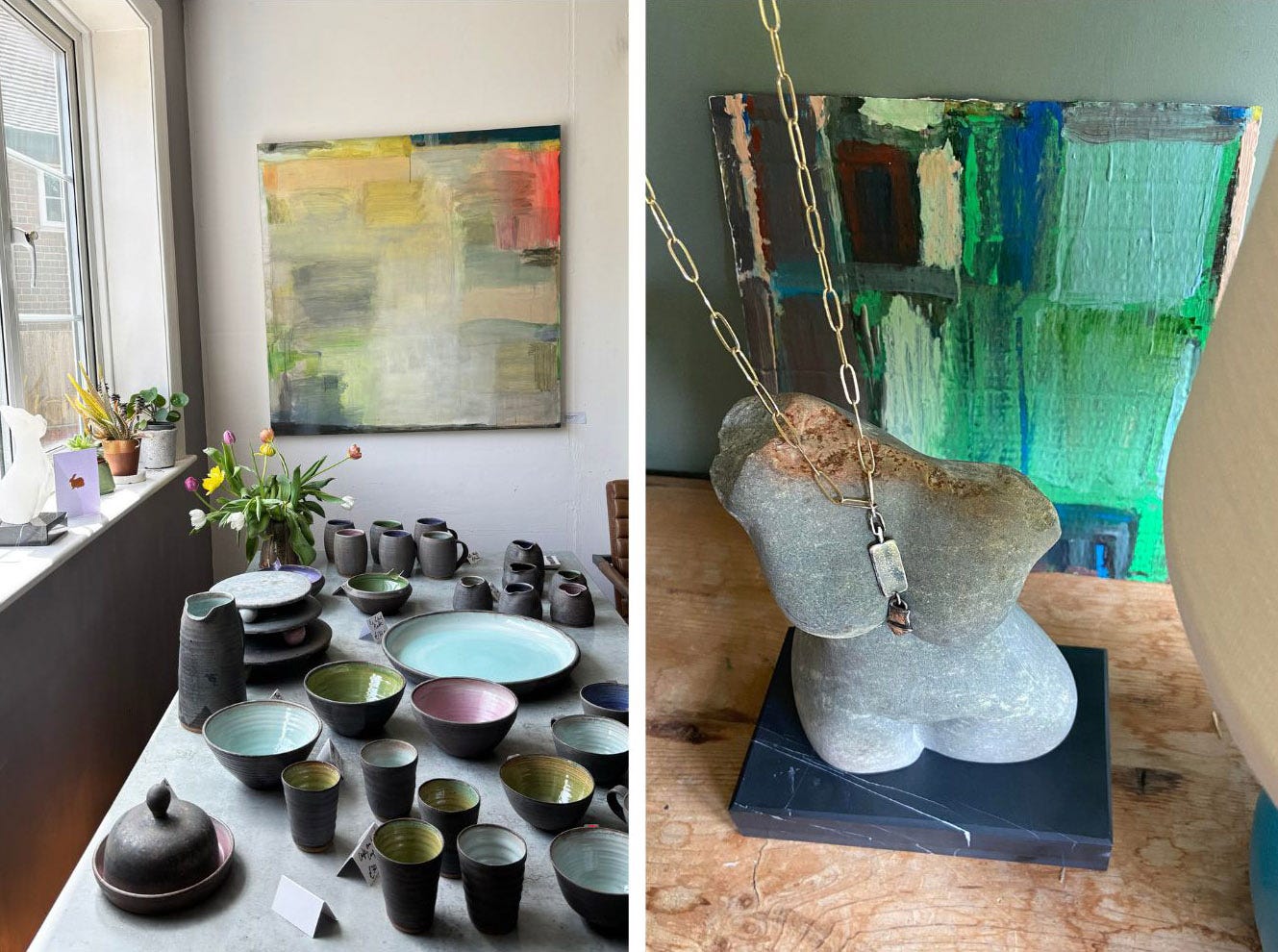
To get the house ready, I’ll take a lot of the personal stuff out, like books, personal photographs, the rug, and some of the chairs, so it’s flowing and uncluttered.
It’s a really lovely process, getting it to that point where there’s nothing jarring, all you’re looking at is the flow of the work and you’re not getting distracted by personal items in the house. It’s really good fun. It’s a lot of work, but you wake up all excited and buzzing to get on with it.
I also really enjoy making the house very calm, and I use aromatherapy oils and incense to make it smell welcoming and relaxed when people walk in.
And finally, where can we find out more about you and your work?
Website: katescottpaintings.com
Instagram: kate_scott_paintings
Artists’ Open House: https://www.hovearts.com